
Samurai Series/Maruni/History
Who carried the crossed arrows?
Before the sword, the samurai’s weapon was the bow. The crossed arrows in a ring are the oldest idea in the Samurai Series, and the one closest to what we build.
The Maruni Edition carries maru ni chigai ya: two crossed arrows, drawn as their nocks and fletching, inside a ring.
It is not the crest of one great house. It was borne by many families, and it is best known through the Hattori of Iga Province, who are said to have spread it. What it stands for is older than any of them: the bow, which for centuries was the weapon that defined a warrior in Japan.
Crests were shared, adopted and varied over centuries, and many family traditions about them cannot be checked. This page says which parts of the story are recorded and which are tradition.
The way of bow and horse
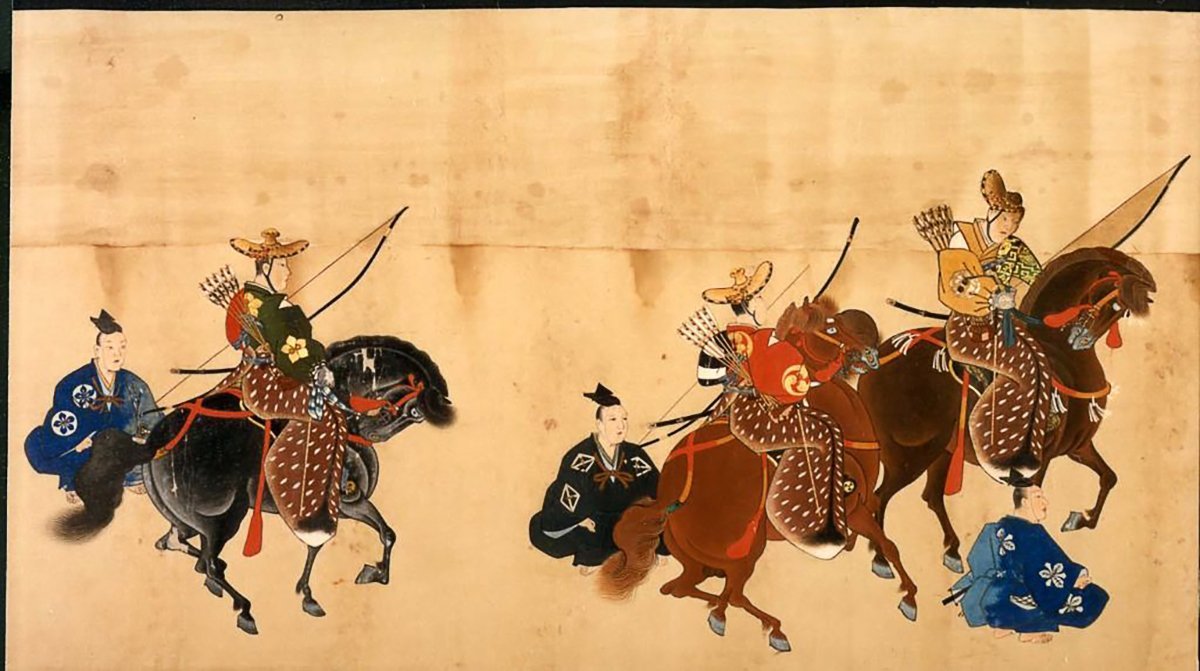
In Japan the samurai were first mounted archers. In the wars of the twelfth century, the men who mattered on the battlefield fought from horseback with the bow, and the ideal of the warrior was called the way of the bow and horse. To take up bow and arrow was a phrase for becoming a warrior.
The spear and the sword rose later. Until the arrival of firearms, skill with the bow remained the first skill a warrior was expected to have.
The language kept the memory. From the age of the Genpei wars, yumitori, “bow-bearer,” was a word for a warlord, and a lord’s standing was measured in part by his archery. Imagawa Yoshimoto, and later Tokugawa Ieyasu, were each praised as the finest bow-bearer of the Tōkaidō road.

From shrine to family
The arrow is older in Japan than any crest. Archaeologists find it in the Jōmon period, and it appears in the Kojiki, the oldest chronicle of Japan. It was a sacred object as well as a weapon: an arrow could drive off evil and purify, and shrines still give out hamaya, “demon-breaking arrows,” as charms. Many shrines took arrows as their crests, and from the shrines the design passed to families, and then spread among warriors, for whom the bow was the mark of their calling.
The crest on this edition does not show whole arrows. It shows only the fletching, crossed. Fletching was cut from the feathers of hawks, swans, chickens and ducks, and hawk feathers were the finest, valuable enough to be given as gifts between warrior houses. The arrows behind this crest are traditionally hawk-fletched, which makes it a close relative of the crossed hawk feathers of the Takanoha Edition.
The ring around them is a common addition. It is often explained as having been added when a branch of a family separated from the main line, though crests were adopted and altered so freely that no single rule covers them.
The family that spread it
The family most associated with arrow crests is the Hattori, who took their name from Hattori in Iga Province. The name itself points to weavers, and the family is said to have served as hereditary priests of the Komiya shrine in Iga, whose own crest showed arrows, set side by side in a ring. One explanation of the Hattori crests is that they came from the shrine.
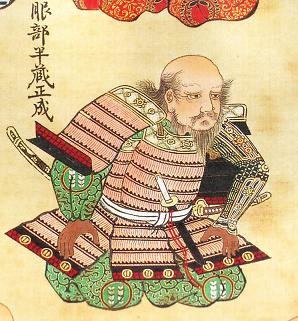
The most famous Hattori is Hattori Hanzō Masanari, a general in the service of Tokugawa Ieyasu, who led men of Iga. Popular culture has made him a ninja master; the record shows a samurai commander. He bore an arrow crest of his own, a different form from the one on this edition: the notched ends of arrows, set side by side inside a ring.
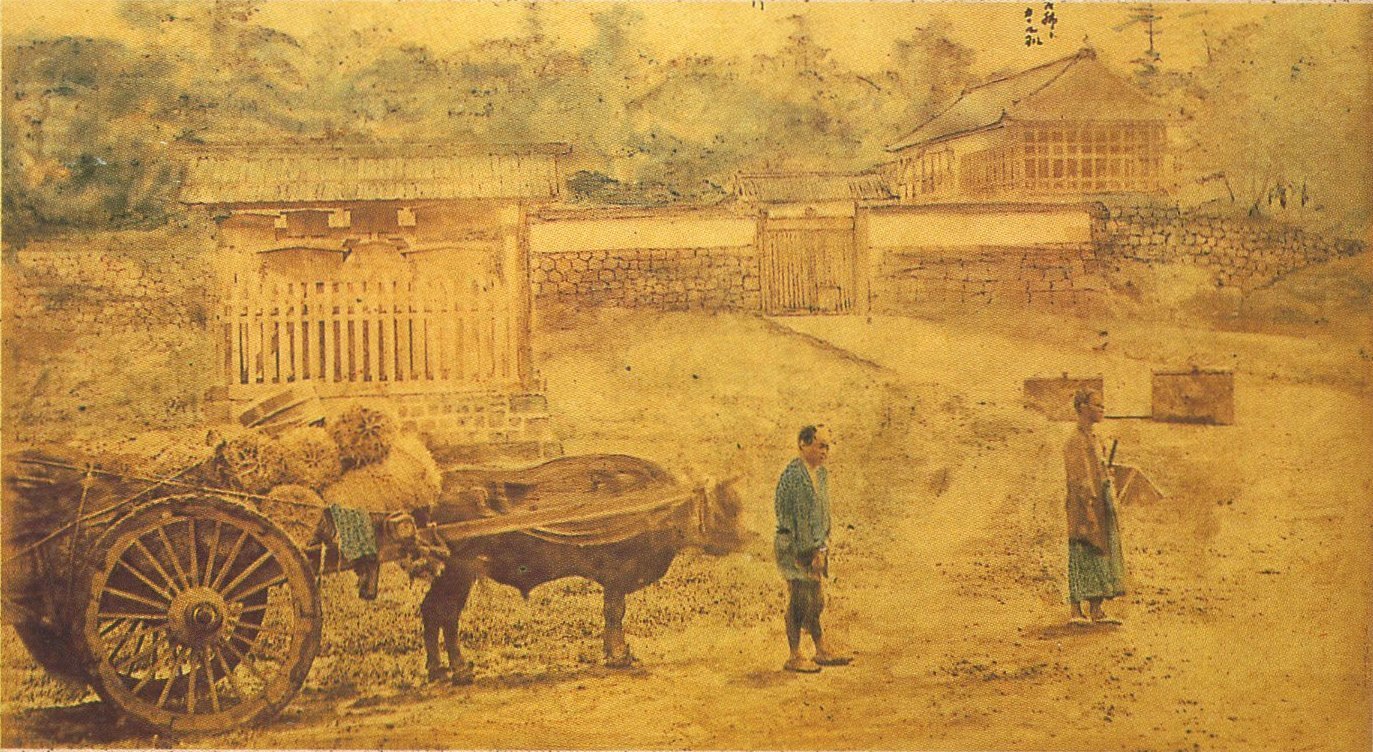
His name is still on the map of Tokyo. Hanzōmon, one of the gates of Edo Castle, is by tradition named for him, because his residence stood beside it. The gate now leads into the grounds of the Imperial Palace, and a subway line and station carry the name.
When the bow gave way
In 1543 Portuguese traders landing on the island of Tanegashima brought matchlock guns to Japan. Japanese smiths were soon making their own, and within a generation firearms were changing how battles were fought. The bow did not vanish; it survives in kyūdō and in mounted archery at shrine festivals. But on the battlefield, the projectile weapon that mattered was now the gun.
A crest at a turning point
When Oda Nobunaga was killed at Honnō-ji in 1582, Tokugawa Ieyasu was near Sakai with a small escort and cut off from home. He escaped through the mountains of Iga. Tokugawa tradition credits Hanzō and his Iga connections with getting him through safely, and historians still debate how large a part he played.
Had Ieyasu died on that road, there would have been no Tokugawa shogunate. It is one of the places where the stories behind the Samurai Series meet: the same night that ended Yasuke’s service ended Nobunaga, and set Ieyasu running.
The arrow in the record
Dates are firm where a contemporary source fixes them. Where they rest on inference or tradition, the marker is open.
- 794–1185Heian period
Crests appear
Emblems begin to mark noble carriages; warriors later carry them on armor and banners.
- 1180–1185Genpei War
The mounted archer
The bow is the warrior’s decisive weapon.
- 1543Tanegashima
Firearms arrive
Portuguese matchlocks reach Japan and are soon copied.
- 1582Iga
The Iga crossing
Ieyasu escapes through Iga after Honnō-ji; tradition credits Hattori Hanzō.
- Edo periodCrests spread
A common crest
Arrow crests are borne by many families across Japan.
Record and legend
Crests were shared, altered and adopted over centuries, and family tradition fills many gaps. Here is where the record stands.
The sources support
- The early samurai were mounted archers, and the bow defined the warrior.
- Arrows were treated as sacred objects, and many shrines used arrow crests.
- Arrow crests were borne by many families, the Hattori prominent among them.
- Hattori Hanzō Masanari was a general in Tokugawa Ieyasu’s service.
- Firearms reached Japan in 1543 and soon displaced the bow in battle.
Often repeated, not settled
- That the crest began with any one person.
- That the ring always marks a branch family.
- That the Hattori crests came from the Komiya shrine. It is one explanation, not a record.
- That the Hanzōmon gate was named for Hanzō. It is the traditional explanation.
- That Hattori Hanzō was a ninja.
- How large a part Hanzō played in the Iga crossing.
Why we honor it
Of all the crests in the Samurai Series, this is the one closest to what we do.
The first precision weapon.The arrow was the samurai’s original ranged weapon, and the archer’s discipline, the same draw, the same release, the same point of aim, is the discipline of the rifleman. The crest honors the skill, not a single family.
Where one weapon handed to the next.The bow gave way to the gun in Japan within a single lifetime. A crest of arrows on a rifle marks that handover honestly.
A crest for the many.The crossed arrows were never reserved for a ruling house. They were carried by warrior families of every rank across Japan.
We keep to the record.Crest histories are full of family tradition. This page marks which parts are tradition.
The Maruni Edition
The Maruni Edition carries maru ni chigai ya, the crossed arrows in a ring.
It is the nickel edition of the Samurai Series. Every Maruni is nickel plated, on a Sharps Bros. Showdown billet lower with a hand-finished menpō mask at the magwell. Two rifles are documented: one with a blue menpō, which also carries the crossed-arrow crest in silver Cerakote® on the stock, and one with a red menpō.


Nickel only
The Maruni Edition is built in nickel plate only. There is no gold Maruni.
Hand finished
Each menpō mask is finished by hand, so no two are identical.
Limited
Built in limited numbers as part of the Samurai Series, on a Sharps Bros. Showdown billet lower.
Sources and further reading
- Hakkō Daiōdō kamon reference, “Maru ni chigai ya,” on the origins of arrow crests, the Hattori and Hanzō’s crest (Japanese).
- Harimaya kamon reference, “Ya mon,” on arrow crests and the families that bore them (Japanese).
- “Hattori Hanzō,” Wikipedia.
- “Tanegashima (gun),” Wikipedia.
- Government of Japan, Highlighting Japan, “Kamon,” November 2012, on the origins of family crests.
Crest histories rest heavily on family tradition, and many cannot be verified. Where this page states a fact, it rests on the sources above; where it reports a tradition, it says so.